The Fur Toilet Seat Cover
by Parker Ahmad
Most people can remember a time when they visited their grandma’s house or that one aunt’s house and finding a fuzzy toilet seat cover that perfectly matched the rest of the bathroom accessories. Here at Liberty Hall, the Kean family had a unique approach to this stylistic choice – a beaver fur toilet seat cover, lined with rabbit fur. Yes, you heard that right; a toilet seat cover made out of real fur. In my years of working with historic textiles, I’d never seen anything like this before, so identifying it was a challenge. As an odd, shaped object with a leather bottom, I was confused about this object’s purpose. It looked like a seat cushion as it has a half-moon shape, but upon realizing that there was an opening in the object, I realized this was meant to decorate a toilet. Not only was the exterior made of fur, the interior part which would hold the actual toilet seat was also lined; meaning your toilet also felt the luxury of quality fur. Now that’s a throne!
While researching more about fur toilet seats – and it’s no surprise that there is not much information available about them – I discovered that they were most relevant between 1945 and 1960. During this time, you could have your toilet seat made from any fur type – real or synthetic – and dyed to any color. The one found here at Liberty Hall is likely constructed from beaver fur externally, with a lining of rabbit fur. The furs were not dyed, so they retain their natural hues of browns, blacks, and grays.
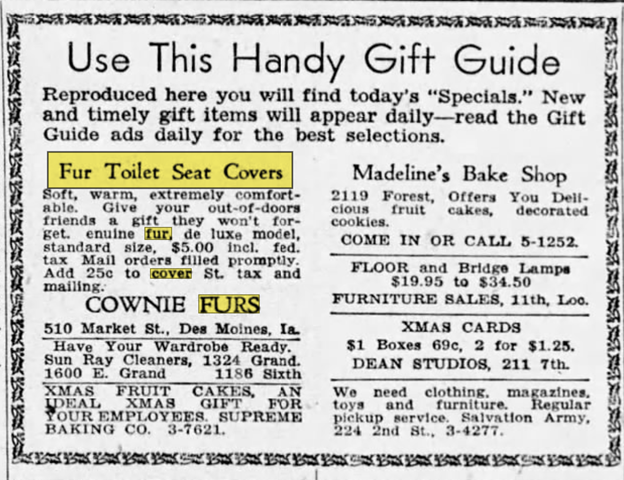
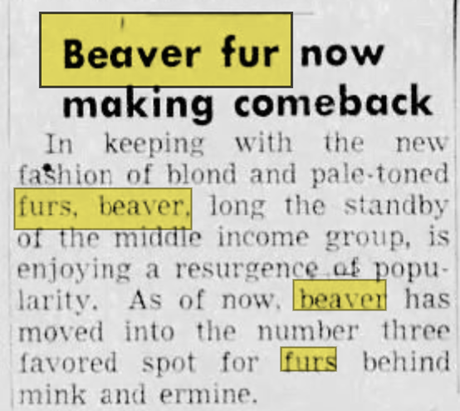
Newspaper articles reveal that beaver furs had a resurgence in popularity during the 1950s. In 1954, according to The Star-Ledger, beaver fur had moved into the third favored spot for furs, behind mink and ermine. At the same time, fur toilet seat covers had taken a place in the bathroom accessory world. But what was the point? Why would someone need a fur toilet seat cover? Well, not only was it fashionable, it was comfortable. An advertisement put out by Cownies Furs for the Des Moines Tribune in 1946 stated: “Soft, warm, extremely comfortable. Give your out-of-doors friends a gift they won’t forget.” They were marketing this item not solely as a fur, but as a feeling, so that one could feel comfortable and in touch with the outdoors while they used the bathroom. This evidence reveals that Liberty Hall Museum’s fur toilet seat cover likely dates to around 1950, due the condition of the fur, the fact that it’s beaver fur, and fur toilet seat covers reached their height in popularity around the later 1940s into the early 1960s.
Using real beaver and rabbit furs is definitely a unique approach to being used as a bathroom textile, but it clearly made quite the luxurious “throne” for the Kean’s family and friends to use.