Secrets of the Past: How We Uncover an Artifact’s True Age
By Tiffany Hite
Any time you visit a museum, you will see artifacts in their displays with little informational blurbs next to them. The blurbs often highlight the date the object was created. For example, a spoon from the Titanic might have a date of 1912. A Victorian dress could have the date circa 1840s or circa 19th century, if its exact date is unclear. Some objects are easier to date than others, and luckily, a curator has many resources available to assist them in this task. I learned this firsthand while researching a tea set in Liberty Hall Museum’s collection.
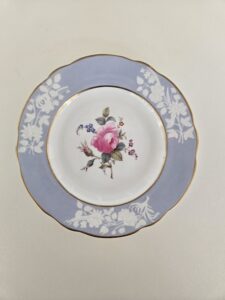
Figure 1: Plate, cake (2012.6.13.29). John Kean Collection at Liberty Hall Museum.
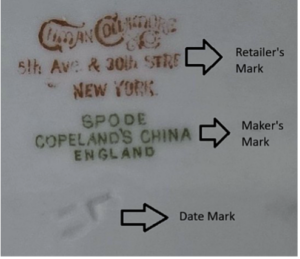
Working with the Collections Department, I recently chose a beautiful Spode tea set to clean and catalog as part of an ongoing project to organize and learn more about the museum’s ceramic collection. Little did I anticipate the research adventure we were about to go on. Our first task was to figure out when and by whom objects in this set were produced. Typically, ceramics will have markings on the back or bottom, which give curators their first clue in the dating game. On the back of this set of teacups and saucers, we found multiple markings that provide clues into the object’s origins: the maker’s mark, retailer’s mark, and date mark. All of these indicate very specific things to the trained curator and interested collector alike, allowing them to narrow down the period the object was made.
While collections research may sound difficult, often the research involves tools available to any interested person, such as reverse image search and resellers’ websites. The easiest place to start is with the pattern of the object. We reverse image searched a picture of the saucer to determine that the pattern of this tea set is Maritime Rose, a pattern produced by Spode, a higher-end ceramics factory in England. Spode was founded in the late 1700s and is still highly acclaimed in the United Kingdom and the United States today. [1] We also gained a lead from Replacements.com, as it mentions this pattern was discontinued in 1972.[2] Now we potentially have the last year that this pattern may have been available for purchase. But when was it first produced? To determine this, we turn to the maker’s mark.
Figure 2: Plate, cake (2012.6.13.27). Reverse. John Kean Collection at Liberty Hall Museum.
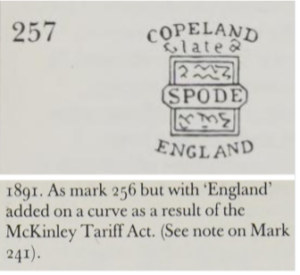
A maker’s mark is the name or symbol placed on the back (or bottom) of an object indicating which company or individual manufactured the item. In the case of our tea set, this mark is stamped on the bottom. For some items in this set, it reads “Spode Copeland’s China England,” and for others, “Copeland late Spode England.” I’m sure you are wondering why the maker’s marks are different if they are manufactured by the same company. Over time, brands often change their maker’s mark, which assists curators, historians, and researchers in determining when objects were produced.
Figure 3: Copeland, Spode & Copeland Marks and Other Relevant Intelligence, 68.
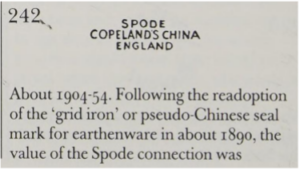
Now that we have identified the maker’s mark, the next step is to determine if it could help us date these items. There are always hobbyists and collectors of ceramics ready to inadvertently aid curators in their search for more information about an item, but curators also need to vet the information taken from these sites. For example, one of the first results from a quick Google search was a blog called Spode History, which gave us in-depth information concerning Spode’s marks. In their post, “Dating Your Spode Pieces,” the author references the book, Spode & Copeland Marks and Other Relevant Intelligence, which was the next clue we needed. We found an accessible copy of the book on the Internet Archive. The book was written by someone affiliated with Spode, which means the information in this book can be trusted. Using this book, we were able to identify specific maker’s mark designs and determine the specific time frames in which each one was used. The “Copeland late Spode England” mark used in some of the objects in our tea set was introduced in 1891.[3] Whereas the “Spode Copeland’s China England” was introduced in 1904 and stopped being used in 1954.[4] Based on this information, we can conclude that this Maritime Rose Spode tea set was produced between 1891 and 1954. The family probably purchased additions to the tea set at different times. But can we narrow this down even more?
Copeland, Spode & Copeland Marks and Other Relevant Intelligence, 70.
We were lucky that many of these saucers also had a letter and two numbers impressed on their bottoms. Impressed marks are symbols that were pressed into a piece of pottery before it had dried. Going back to our handy Spode & Copeland Marks book, we learned that these are date marks and that the letters correspond to the month, and the numbers to the year that this item was produced.[5] For example, on one saucer, there is a “L 11,” which reveals that the saucer was manufactured in July 1911.
Figure 5: Copeland, Spode & Copeland Marks and Other Relevant Intelligence, 93.
For objects that don’t have a date mark on them or whose date marks are illegible, there is still one more way to narrow down when they were produced – the retailer’s mark. This is the stamped mark that indicates where the object was purchased. By returning to the back of our saucer, we can see a stamped mark reading “Gilman Collamore & Co.” which operated at “5th Ave & 30th Street, New York.” Although this does not immediately reveal much about the object itself, a quick search brought us to a history of the Wilbraham, the building located at this address. Gilman Collamore Co. set up its business in the Wilbraham in 1908 and moved to a different location in 1920. This means any teacup or saucer with this retailer’s mark was produced and sold between 1908 and 1920. With this final piece of the puzzle, we can finally complete our quest to date this tea set.
Gathering all of these clues allows us to learn more about an object’s history, which also gives us an idea about the people who purchased it. From the maker’s mark, we know that Spode, a higher-end but not inaccessibly expensive manufacturer, produced this tea set, which was likely used for regular entertainment. Additionally, if we did not know who produced these items, the date marks would be unintelligible since each manufacturer uses a unique design. This context helps us to determine which members of Liberty Hall’s Kean family purchased and used these items. Finally, we can deduce where the tea set was purchased with the retailer’s mark. Gilman Collamore & Co. was a popular store for wealthier families to frequent, providing clues into where the Kean family shopped around the turn of the twentieth century. Knowing more about the company that produced the object and the retailer that sold it gives us more context about the Kean family’s life. Understanding more about their lives gives us insight into how other families in their community may have lived as well, allowing us to provide visitors with a more accurate understanding of the past.
As you have read, dating objects is not always as simple as looking at the item. Sometimes, it can take hours of research as the curator goes from one piece of the puzzle to another. It’s a history-themed mystery — and the thrill of the chase is half the fun.
[1] More information concerning Spode can be found here.
[2] Cynthia Findlay’s website also states this pattern was discontinued in 1972.
[3] Robert Copeland, Spode & Copeland Marks and Other Relevant Intelligence (London: Studio Vista, 1997), 68.