Victorian “Photoshop”

By Parker Ahmad


Today, photography is extremely ubiquitous. We always have cameras right at our fingertips, ready to snap anything and share it online. With social media, came the normalization of photo retouching, or at least that’s what many people believe. Photo retouching is nothing new to the fashion industry, with magazines and advertisers frequently editing models to idealized and unrealistic beauty standards. But retouching personal photos is much older than TikTok filters, originating with the Victorians.

The first surviving photograph was captured by Nicéphore Niépce in 1826. By 1839, Niépce’s partner, Louis Jacques Mandé Daguerre, gave the first public lesson on the photogenic process of capturing images and turning them into “daguerreotypes.” Within the next few years, scientists worked hard to find more efficient processes to take photographs, including William Henry Fox Talbot, who invented the calotype process. This new ability to capture and print an image transformed the way people interacted with print media. Unlike in portraits, there was no hiding imperfections in a photograph. But that did not stop people from trying to edit themselves to appear as perfect as a painting. Here at Liberty Hall, we have one such photo that demonstrates how people retouched their photographs in the early years of photography.

https://libertyhall.kean.edu/wp-content/uploads/2026/03/unnamed.png
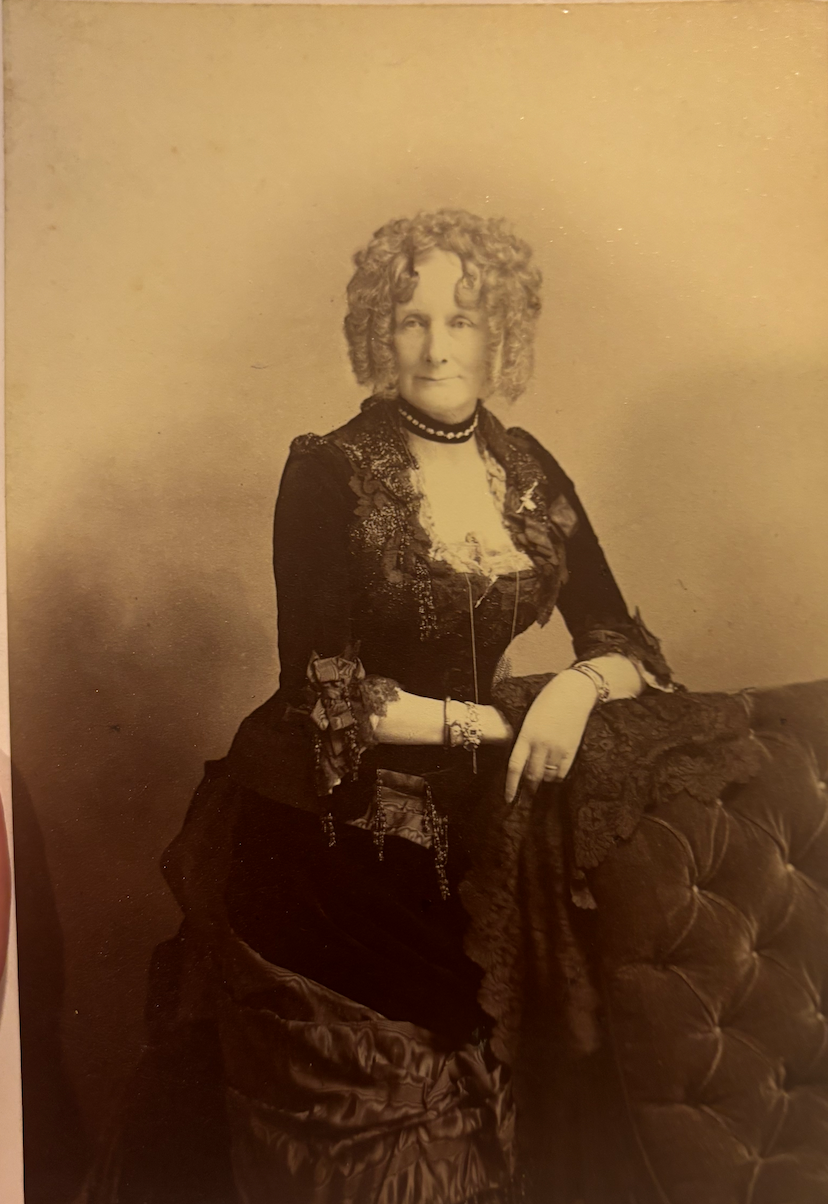
Photograph of Julia Ursin Niemcewicz (Kean) Fish that demonstrates Victorian Era photo retouching. John Kean Collection at Liberty Hall Museum

At first glance, this photo seems as perfect as a painting. But can you see where edits have been made to erase blemishes and idealize her figure? If you said her waist, hand, and skin, you’d be correct. While it may be hard to spot, the shaded area just to the right of her hip is actually an indication of one of the retouching processes. The purpose of this was exactly as it is today, to appeal to the ideal body types and fashionable standards of the time. During the latter half of the Victorian Era, tiny nipped-in waists were extremely fashionable, making this a frequent subject of retouching. One account featured in the Evening Press on December 8, 1881, recalls: “Small waists are again in fashion. What they will come to … is difficult to conceive. ‘The waist feminine has now reached the hourglass stage, and is rapidly approaching the wasplike dimensions which may fitly be characterised as next to nothing.”

Close up of the above Victorian photograph
Close up of Julia Ursin Niemcewicz (Kean) Fish’s waist. John Kean Collection at Liberty Hall Museum.

Spots like this are present in many Victorian Era photographs and indicate where the retoucher “removed” the body. Photography: The Journal of The Amateur, The Profession, and The Trade Volume 4, published in 1892, describes how the waist was edited, stating:

“Ambitious Amateur” may slice off, or curve the lady’s waist after his own idea of shape and form and size, by first mediumising the negative and applying the retouching pencil either by stippling or comma-like touches. Supposing, for example, the lady’s waist is straight, make a curved pencil line commencing about half-way between the arm and waist, gradually taking off more of the figure until the waist is reached, then more suddenly curving outwardly again over the hip, tapering off the line gradually. After this graceful curve is made, it is a case of stippling out with a pencil that part of dress which is cut off into the background, making it match as near as possible.

Today, this gray area indicates where the stippling – or engraving – has taken place and is how researchers are able to study the Victorian Era “photoshop.”

https://libertyhall.kean.edu/wp-content/uploads/2026/03/Screenshot-2026-03-17-at-2.42.13 PM.png
Photograph of Emily Soldene as Madame in Madame L’Archiduc, “Guy Little Theatrical Photograph,” Photograph, late 19th century, The Victoria & Albert Museum. Demonstrates an indication of photo retouching at the waist.

The waist is not the only indication of retouching on the photo of Julia Ursin Niemcewicz (Kean) Fish. Upon closer inspection, one can see that her fingers and hand were also edited to appear slimmer. This was done using dark ink or a pencil to color over the skin. This allowed the edited part to blend into the fabric on the chair where the hand is resting. Something like this is minute, but it assisted in the illusion that this woman was thinner.

Close up on a Victorian photograph, showing evidence of retouching in the hands.
Close up of Julia Ursin Niemcewicz (Kean) Fish’s left hand. John Kean Collection at Liberty Hall Museum.

Retouching could also be done to make the subject appear more youthful. As we see in the photograph of Julia Ursin Niemcewicz (Kean) Fish, her skin is perfectly smooth, without a wrinkle in sight, despite being an older woman. So how did she get such perfectly smooth skin? An article featured in The El Paso Journal on June 23, 1888 explains just that, stating: 

Photography has been called “justice without mercy,” but by retouching the sitter can be made to look much younger than is real. Retouching the negative is done in a dark room with a small opening in a frame that covers the window. The negative is placed over this small opening, and the workman, by the use of pencil and brush, removes all the roughness of the skin, and can remove all frowns and lines.

This form of retouching is what allowed Julia Ursin Niemcewicz (Kean) Fish’s skin to look much younger, while her face retained some identifiers of her real age. 

Retouching was not only done on older women. When photographer Tony Richard took a closer look at some albumen plates, he was able to clearly see the scratch marks that made the skin appear smoother. However, these scratch marks were present both on the woman and the child, meaning everyone took part in retouching. 

A posed Victorian photograph featuring a seated woman and boy
Tony Richards. Featured in Erin Blankmore, “Here’s How Victorians ‘Photoshopped’ Photos,” Smithsonian Magazine.

Close-up of a Victorian photograph of a woman and boy, featuring retouching scratches on their faces.

Contemporary sources reveal that men were both the ones doing the retouching and the ones instigating this trend.  Not only did retouching allow women to fit a man’s ideas of shape and form, but some women also blamed men’s tastes for the expectation of impossibly small waists in the first place. In Evening Press a woman named “Sylvia” was quoted regarding woman’s beauty standards: 

“Sylvia”… roundly charges the men with having brought into existence and perpetuated the fashion of tight-lacing. She declares that whenever she uttered a strong protest in the journal she edits against “squeezing the waist,” she has invariably received letters from men praising a “cypress waist…” “Sylvia” attributes the tight-lacing of women to the idea imbibed in intimacy “that their first duty is to make themselves pleasing to the eyes of  men.”

Fashion allowed women agency, but women understood that they lived in a male-dominated society and that this culture impacted how they interacted with their bodies.  

Given this, women still had a place in the world of photograph retouching, as photography opened doors to new career opportunities for them. As reported in the Chicago Tribune on August 2, 1874: “Photography is an art requiring deft skill, delicate manipulation, and an artistic eye; these qualifications render it a profession particularly fitted for women to follow… As a result, women occupied every sphere of the photography industry, from selling photographs, planning and executing them, and even editing them. Retouching was also one of the best paid positions in the industry. The newspaper reports that “…good negative retouchers [could] easily [obtain] salaries of $18 a week…” This $18 a week was substantially higher than most wages women would be given during this time. For example, a family sewer from Chicago in 1877 would have been making $1 to $1.25 a day ($7 to $8.75 a week if they worked 7 days). A first class dressmaker from Washington D.C. in 1875 was only making $1.50 per day ($10.50 a week if they worked 7 days). Teachers in Michigan in 1872 would have only made $250 for the entire school year. While these are not averages and more skilled professionals may have been paid higher wages, it gives a comparative analysis of just how much more women could make in photograph retouching.

From this research, it becomes clear that people’s thoughts around their image have not changed much in the last 200 years. The Victorian era photoshop was done to adhere to fashion and societal standards, many of which seemed to have been propagated by men. At the same time, photography and photo retouching gave women a new opportunity to make a substantial amount of money. Print media altered the ways in which people interacted with art, and photographs continued to transform this. While there are both negatives and positives around photo retouching, it does make me wonder what retouching would look like if Victorian people hadn’t normalized the trend.