Who was Enslaved at Liberty Hall?: Henry
All that we know about Henry comes from letters written by William Livingston, his enslaver. Although this is a common source for information about enslaved people, it is necessary to carefully read these sources in order to gain a better understanding of who Henry was. Enslavers such as William Livingston often did not recognize the full humanity of the people they enslaved and the ways in which they wrote about enslaved people reflects this bias. At the same time, enslaved people would not have shared their inner lives and motivations with their enslavers. Henry’s personal history is a poignant example of how we can read between the lines of sources to learn more about enslaved people.
Henry first appears in a letter from William Livingston to his wife, Susannah French Livingston. Identified as possibly a German indentured servant by the Papers of William Livingston, Henry’s story involves a great deal of uncertainty.
Although indentured servants and enslaved people were both unfree laborers, there are a number of key differences between them. Indentured servants entered into a contract with their employer, with the understanding that they would eventually be free to leave. They would receive some form of compensation for their labor. An enslaved person, in contrast, did not sell their labor. Instead, other people claimed and sold their personhood. They did not enter into any sort of contract with their enslaver and did not have any choice in who they would serve. It was not their labor that was sold, but their bodies. Indentured servitude was also not hereditary. Children born to an enslaved mother would be enslaved, but children born to indentured servants would be free. By the eighteenth century, slavery was race-based. A Black person might be an indentured servant but a white person could not be an enslaved person. This meant that by the 1820s, the New Jersey Supreme Court ruled that a Black person could legally be assumed to be enslaved without any additional evidence.
Given the available evidence, it is difficult to determine with full confidence whether Henry was an enslaved person or an indentured servant. For this reason, Liberty Hall has determined to engage with the possibility that Henry was enslaved.
Who was Henry? We only know him in the context of his labor but there are some things that we can glean of his personality from Livingston’s letters. He was clearly willing to stand up for himself and was unwilling to accept enslavement or involuntary servitude. He would have had connections with other laborers at Liberty Hall, including Bell and Lambert, although it is difficult to know what their relationships would have been like. His family and personal relationships are absent from William Livingston’s letters, which only feature him in relation to his labor.
First mentioned by Livingston on February 19, 1786, it is clear that Henry was dissatisfied with his life at Liberty Hall. He asked Livingston to sell him because he “could not work.” Why would an enslaved person or indentured servant request to be sold? Livingston believed it may have been related to an interpersonal dispute with a servant. It is also possible that Livingston gave Henry tasks that were too physically challenging for him. Enslaved people were also known to request sale in order to unite them with family or community members from whom they were separated. While it is impossible to know what exactly were Henry’s motivations, it is clear that he did not want to be bound to Liberty Hall or William Livingston.
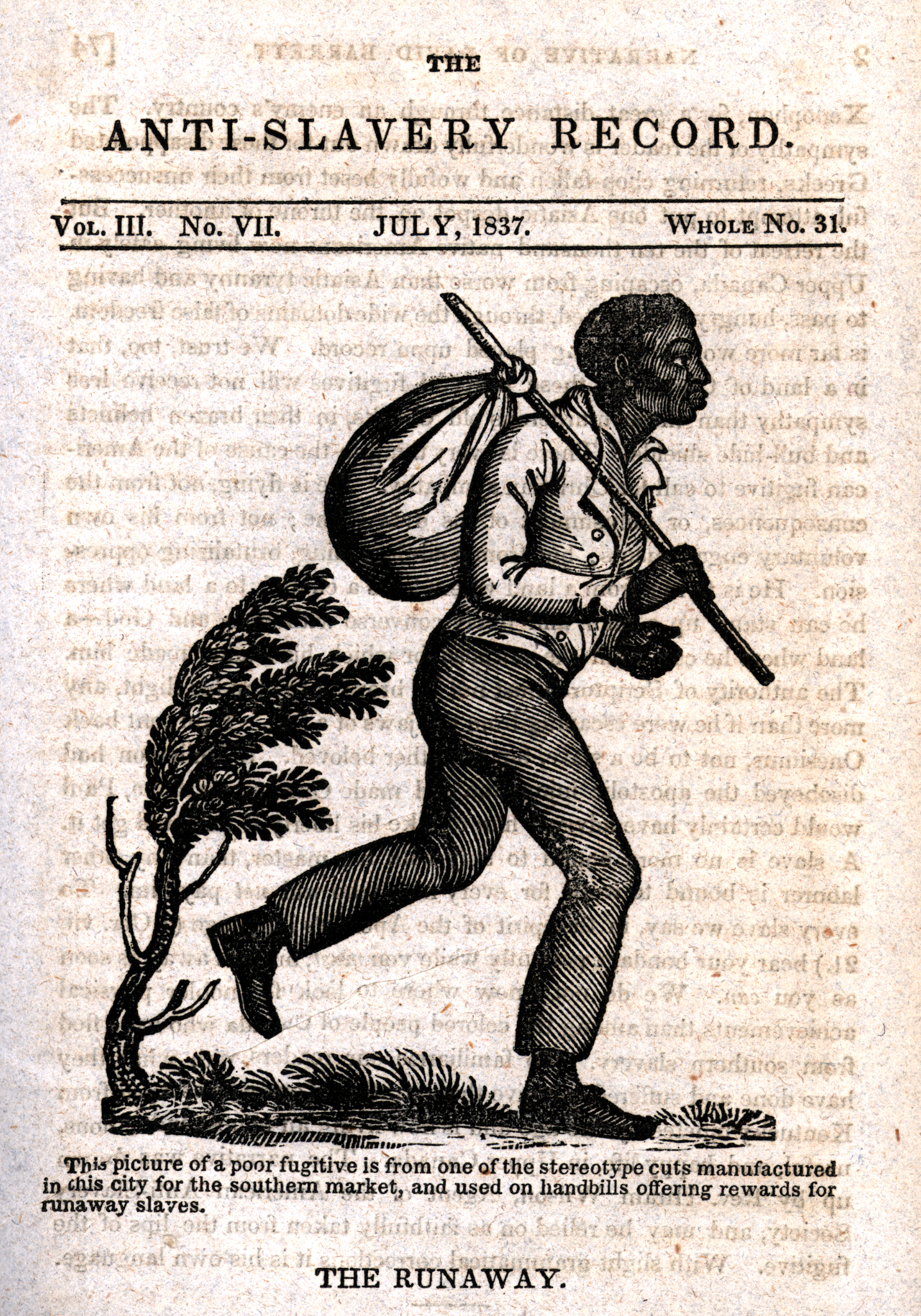 American Anti-Slavery Society. “The Runaway,” 1837. The Library Company of Philadelphia.
We can’t know for certain why Henry chose this moment to escape. William Livingston thought he was trying to avoid work, as the planting season had just begun. Perhaps Henry hoped to take advantage of the time of year to find paid agricultural work.
When Henry self-emancipated in May 1786, William Livingston already understood that slavery was immoral. He had already asked New Jersey’s assembly to work towards manumission and was only weeks away from joining the New York Manumission Society. How then did Livingston react to Henry’s escape? He was critical, called Henry lazy, and asked his son-in-law John Jay to find an inexpensive laborer to replace him.
By Katherine Quigley, February 2026
Henry’s choices were his own, but they also reflect larger trends in post-Revolutionary New Jersey. Self-emancipation, especially for younger men, was on the rise. William Livingston gave no indication of where Henry might have gone, but if he did not find work in agriculture, he probably travelled to New York City, the likely destination for most of the young men who self-emancipated in the years following the American Revolution.