Betty was a mother, who, with her several children, was enslaved by Susan Niemcewicz in Elizabethtown. She and her young children feature heavily in correspondence between Susan Niemcewicz and her husband Julian Niemcewicz, revealing the ways in which an enslaved mother could and could not resist enslavement.
Who was Enslaved at Liberty Hall?: Betty and Her Children: Philip, Sarah, Plymouth, Violett, and Stephen
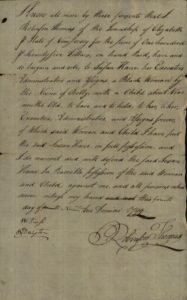
Susan Kean (later Niemcewicz) purchased Betty and her infant son Philip from a man named Robinson Thomas in 1799 for $175. Betty would go on to have several children, all of whom would be claimed by Susan Niemcewicz and forced to labor for her throughout their childhoods.
Betty had several other children during the time she was enslaved to Niemcewicz. In addition to Phillip, her family included Sarah, Plymouth, Violett, and Stephen. A mother of several children, Betty was responsible not only for cooking and cleaning for Niemcewicz, but also caring for her infants and toddlers. We do not know how Betty experienced motherhood. She, like other enslaved mothers, probably felt both joy from being with her family and fear that her children would be taken from her.
As was the case with many families enslaved in northern cities, Betty’s husband lived elsewhere. It is unknown whether he was enslaved or free, but he was permitted to visit Betty and their children in the evenings. Although Betty and her children would have been glad to see their husband and father, Niemcewicz likely allowed these visits primarily out of her own self-interest. Enslavers like Susan Niemcewicz were aware that Black women’s childbearing potential could make them wealthy. Niemcewicz would write to her husband about Betty’s childbirths and speculate on the labor that these children would perform for her in the future. In this way, enslavers like Niemcewicz commodified Black motherhood.
Betty was aware of her and her children’s vulnerability and chafed against her enslavement. As a mother of several young children, self-emancipation would have been extremely difficult so she resisted in more subtle ways, like speaking her mind and refusing to behave subserviently. Susan Niemcewicz did not recognize this as resistance instead, she believed that Betty was an unpleasant woman and documented her frustrations. Because the only available sources we have about Betty come from her enslavers, we cannot take them at face value. Betty not only had to keep parts of herself hidden from her enslavers, but the ways in which they understood her behaviors were impacted by self-interest and racial prejudice.
Even this more subtle resistance turned out to be a huge risk for Betty for Betty. Susan Niemcewicz threatened to sell her several times, but made it clear to Betty that she planned to keep her toddler and infant children. Niemcewicz had no qualms about weaponizing Betty’s love of her children in order to make her obey, writing to her husband Julian that Betty “knew her own interest too well to accept the discharge.” With this threat in mind, Betty “learned to bridle her tongue” and became “attentive” (Susan Ursin Niemcewicz to Julian Niemcewicz, Feb. 4, 1803, Liberty Hall Collection at Kean University)
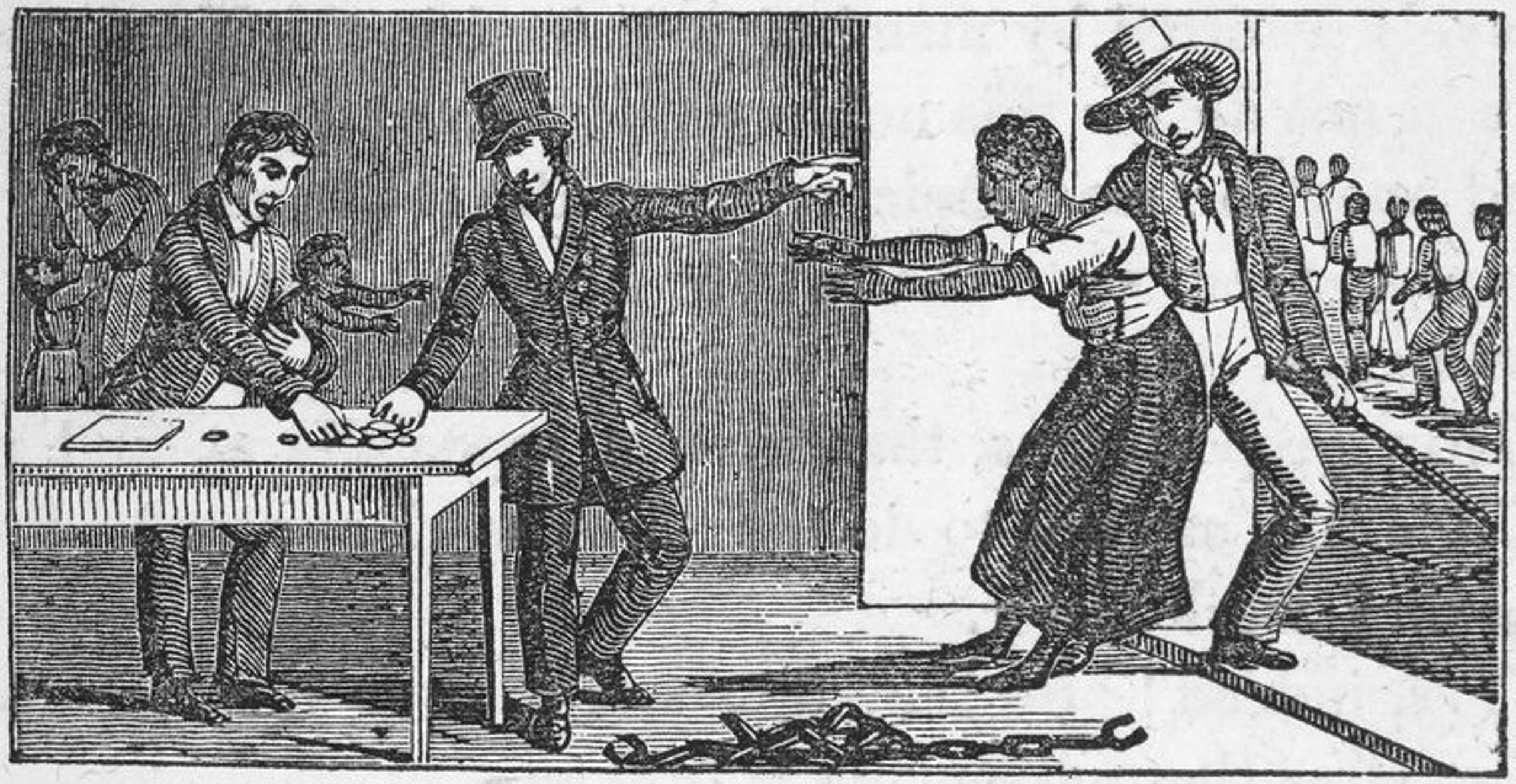
From Betty’s subtle resistance, we can learn how much Betty loved her children as well as how much she feared losing them. But even though she had to be extremely careful, Betty continued to resist. Not long after threatening to separate Betty from her children, Susan Niemcewicz complained that Betty took too long to put dinner on the table. It is possible that Betty decided to work slowly and delay meals as a way to voice her unhappiness in a way that kept her and her children safe.
Betty’s children grew up in this precarious position. Susan and Julian Niemcewicz wrote about them with affection but at the same time demanded they spend their early childhoods at work. Even as toddlers, they assisted in the garden, served tea, and more. Although they sometimes wrote about these children warmly, Susan and Julian’s letters always made it clear that they viewed these children as commodities, with Julian asking Susan to send him one of the girls as a present or Susan teaching Phillip to bring Julian his slippers. The nature of slavey in urban New Jersey meant that enslaved families lived alongside their enslavers in close quarters, but these relationships were still based on force and control.
At this time Betty and her children lived alongside two enslaved teenagers, Thomas and Eve. It is possible that Betty cared for these teenagers, and perhaps they watched over her young children when she could not. Both Thomas and Eve eventually self-emancipated from Niemcewicz’s home. Because she had young children, Betty’s options were more limited, but she may have encouraged Thomas and Eve to live freely, and perhaps Betty’s children saw them as role models.
We do not know exactly what happened to Betty, but she may have been comforted to know that several of her children would eventually be free. Violett and Stephen were born after New Jersey passed a gradual emancipation law in 1804, so Violett would be free when she turned 21 and Stephen at age 25. There are few references to Stephen or Plymouth after their infancy, so it is possible that they died young. By 1810, Violett and Betty were bound out to another home in Elizabethtown. It is unknown where they lived or whether they remained together, only that their wages went to Susan Niemcewicz.

By the time Susan Niemcewicz moved into Liberty Hall in 1811, only Phillip and Sarah were brought with her. Because Liberty Hall was on the outskirts of Elizabethtown, the children likely had few opportunities to visit their family. Both born before gradual emancipation, Susan Niemcewicz was legally entitled to their labor for the rest of their lives. They may have taken comfort in one another. Susan Niemcewicz did not record any information about their relationship with one another, but we do know that as a young child, Phillip was affectionate toward Sarah, whom he spoke of with pride. If they remained close as older children and adults, Susan Niemcewicz did not record it.
Phillip was mentioned in Susan Niemcwicz’s letters until 1825. After this, it is unknown what became of him. Niemcewicz planned to manumit him in her will from 1820, but we have not yet located an official manumission document for him.
It is possible, although unconfirmed, that Sarah was actually Sarah Van Horne. If this is true, she eventually lived as a free woman with her husband Peter and son Robert, living to see the births of several grandchildren in freedom.
By Katherine Quigley, February 2026